The shift to AI-powered search has changed everything: how people search, how your website content should be written, and even how paid search campaigns work in Google. Meet GEO, Generative Engine Optimisation, aka Answer Engine Optimisation, which has transformed SEO for 2026 and beyond.
SEO vs. AI Search: Key Differences Explained, How it Impacts Paid Search Results, and What it Means for Your Business
TL;DR: SEO isn’t dead… but it’s no longer the start of the digital show.
Meet GEO, Generative Engine Optimisation (aka Answer Engine Optimisation, if you like acronyms). While SEO was about ranking links, GEO is all about being the answer that AI-powered search tools like ChatGPT and Google’s AI summaries actually show.
The shift to AI-powered search has changed everything: how people search, how your website content should be written, and even how paid search campaigns perform. Want to know how to stay visible, relevant, and click-worthy in 2026? Keep reading, we break down what GEO means for your content, your audience - and yes, even your Google Ads.
From SEO to AI GEO: What’s Changing in Search
Traffic to your website down? Search ads not working like they used to? You’re not imagining things. The SEO landscape has completely changed, and if you’re not optimising your content for AI then, sadly, you’re being left behind.
For years (literally decades!), SEO has been the name of the game. Ranking on Google, optimising keywords, and building backlinks were the foundations of digital visibility. But, like every other aspect of digital life, AI has massively changed how search engines work.
Today, people aren’t searching the way they used to, and Google doesn’t work like it used to either. As Chris, our head of web, puts it:
“Google is no longer a website search engine, but a content search engine.”
And that’s a big difference.
So, what does AI search actually mean for your business, your website content, and even your paid search strategy? Let’s break it down.
What Are Generative Search Engines and Why Do They Matter?
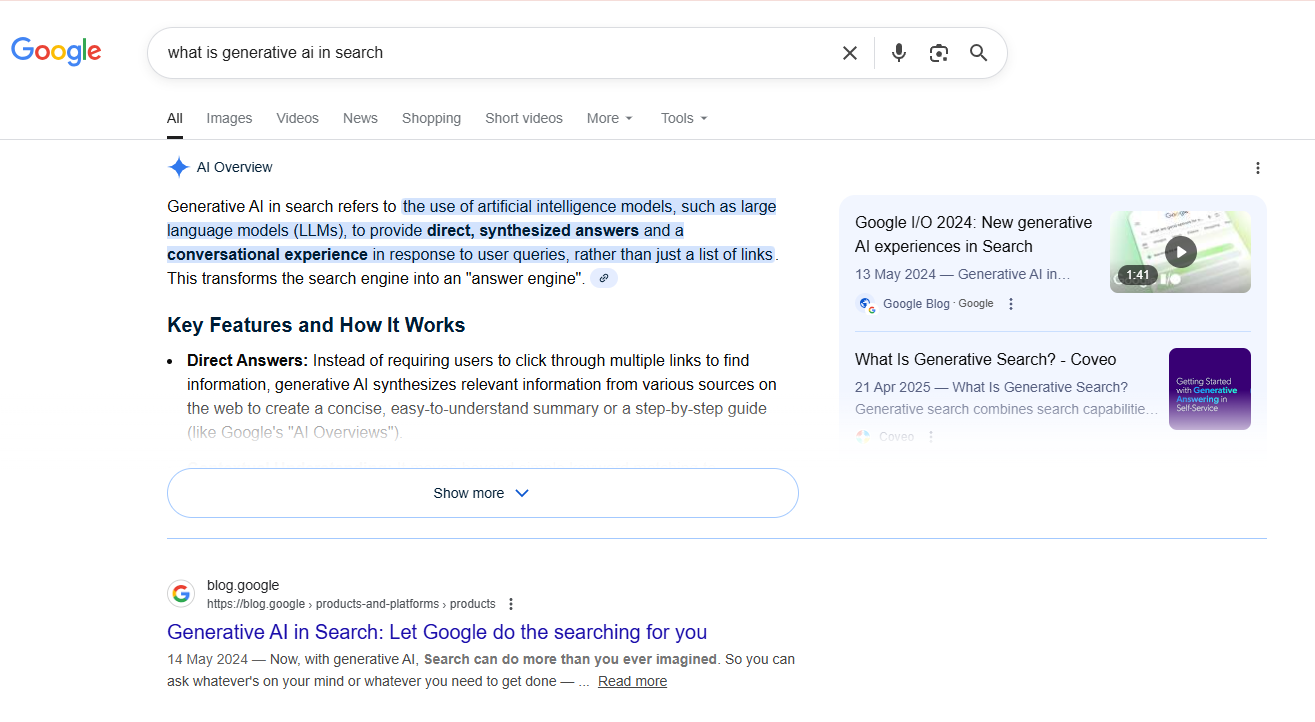
Think about the last time you Googled something, like “how to fix a leaking tap.” Chances are you probably got a complete step‑by‑step answer before you even reached a search page - that’s what AI generative search does.
Generative engines are AI-powered search tools that generate answers, rather than simply listing links. Instead of scanning search results and clicking through multiple websites, users get a single, summarised response that’s contextualised, conversational, and often personalised.
A traditional search engine lists articles, forums, and videos, whereas a generative engine delivers a step-by-step explanation or detailed answer, written in conversational language, sometimes with images or videos, all pulled together from multiple sources across the web in one easy-to-read and hyper-personalised response.
Tools like ChatGPT, Google AI Overviews, and other large language model-powered search experiences are fundamentally changing how information is delivered - and for businesses online this is a massive shift in how visibility is earned.
What Has AI Changed in Search?
Historically, search engines like Google displayed a list of links based on factors like keywords and paid search ads. Users would scan results, click through to websites, and consume content manually. Click-through rates and traditional rankings were reliable measures of success, and SEO strategies were built around them.
Now, generative AI tools often provide direct answers to search queries. In tests across tens of thousands of queries, AI overviews appeared in 47% of all searches and in a majority of informational queries - a whopping 73% for long-tail searches. When these AI-generated summaries appear, traditional links are pushed further down the page, and click-through rates drop significantly. (Source)
Searching a long-tail question now typically shows an AI-generated answer, which draws its information from sites deemed most relevant by their AI-powered search.
This means that users will skim the AI answer and get what they were looking for, without clicking on your site - so it’s not a game of clicks anymore, but about ensuring that the AI answer is sourcing its info from your site to get in front of your target audience online.
Google Ain’t the Only Search Engine in Town No More
Another major shift is the rise of AI chat tools as standalone search experiences. More and more people are turning to ChatGPT and other AI tools as their first stop for information or problem-solving queries.
According to a 2025 survey by Adobe, 77% of ChatGPT users treat it like a search engine, and nearly one in four people start their searches in ChatGPT instead of Google, with this behaviour particularly strong among younger users. (Source)
Even though Google still handles far more total search volume - traditional engines still account for roughly 90% of total search traffic - these AI tools are seeing an ever-growing base of users, changing both how people search and what they expect from results.
This behavioural change reinforces the importance of Generative Engine Optimisation (GEO), sometimes called Answer Engine Optimisation (AEO). GEO isn’t just about ranking in search results anymore; it’s about making your content the answer AI-powered search engines choose to generate, whether users are searching via Google, ChatGPT, or other AI platforms.
Users increasingly bypass traditional links in favour of quick, summarised, conversational answers, and this has direct consequences for businesses: click-through rates are no longer the only measure of visibility. Success now means being included in the AI-generated answer itself, where users see your content first - and if your website and content isn’t made for AI generative engines to crawl and cite, then you’re basically invisible. That’s why GEO is critical.
So, What Exactly Is GEO, and how is it Different to SEO?
SEO, or Search Engine Optimisation, focuses on helping your website rank higher on traditional search pages using keywords, backlinks, and other ranking signals. GEO, on the other hand, focuses on helping your content be included and cited in the answers that generative engines provide.
While this might sound like a pretty small distinction, it completely changes how you need to think about content. With SEO, success was measured by rankings and organic sessions. With GEO however, success is being referenced within an AI answer because that’s often where users see information first.
GEO still borrows from SEO fundamentals: your content needs to be clear, authoritative, and trustworthy. But it also pushes you to think about how AI tools understand and extract answers from your content, and how your information can be presented as a concise, complete, and human-friendly response.
Why Does GEO & AI Search Results Matter for My Business?
There’s three practical reasons this shift towards AI search results matters for your business:
1. Users are clicking less. When AI answers appear, users get what they need without clicking through. Studies show that when those overview responses show up, click-through rates for both organic results and ads drop significantly. (Source)
2. Traditional rankings don’t guarantee visibility anymore. A page ranking at the top of Google doesn’t mean users will actually visit it if an AI answer already gives them what they need.
3. Reference and citation matter. Being cited by an AI answer still builds awareness and authority - even if people don’t click through to your website. And when AI systems do send clicks, these users tend to spend more time engaging with the content compared to old-fashioned search visits.
This doesn’t mean SEO is useless though. SEO still helps people find your website and can feed into AI visibility. But, if you’re only optimising for search rankings, you’re missing how the new generation of search actually delivers answers. (Source)
What Does GEO and AI Search Mean for my Website Content?
With GEO, the focus should be on clarity, structure, and usefulness.
Here’s what that looks like in action:
· Write for real questions people ask. People are asking in longer, conversational ways, not just short keywords. For example, “What are the best running shoes for beginners?” is closer to how someone actually asks a question in AI tools, as compared to traditional search which looked more like “Best running shoes”.
· Structure your content so it’s easy to extract. Clear headings, definitions, concise explanations, and answers that can standalone help AI models pull the right parts of your page into a generated answer.
A good AI-friendly example would look something like: “Best running shoes for beginners: Lightweight, cushioned, supportive with a neutral sole for most foot types.”
Whereas poorly optimised copy would be hard to scan, have no clear answers, and the info would be buried in a long sentence… like this: “Choosing running shoes depends on foot type, experience and comfort, which may vary for everyone.”
· Use multiple content formats. AI answers often mix text with images, videos, FAQs, or quick facts. Having varied formats makes it more likely your content will be useful to an AI summariser.
· Keep content up to date. AI models and search interfaces both prefer fresh, accurate information. Outdated pages are less likely to be included in answers.
You’ll notice that many of these practices are already good SEO, but with GEO, the emphasis is on extractable, authoritative content that aligns with how AI generates answers.
What GEO Means for Paid Search and Google Ads
GEO doesn’t just affect organic search and has changed how paid search works and where Google Ads fit into the customer journey.
Like I said before, AI-generated summaries sit at the top of the page when they appear in search results, which means traditional ad placements are competing for attention in a different way than they used to. Paid search isn’t disappearing, but it is becoming far more intent driven.
Fewer clicks, stronger intent: With more information being delivered directly in AI summaries, users tend to do more research before clicking anything. When they do click on an ad, they are often further along in the decision-making process. For advertisers, this can mean lower click volumes but higher-quality traffic. Landing pages, offers, and conversion paths matter more than ever, because the users who arrive are closer to taking action.
From keywords to intent signals: While keywords still play a role, Google Ads now relies far more on intent signals such as behaviour, context, and conversion data. Campaign types like Performance Max and AI-assisted Search campaigns are built for this environment, allowing Google’s systems to decide when and where ads appear based on the likelihood of conversion. Success in this model depends less on manual keyword control and more on strong measurement, clean data, and clearly defined goals.
Creative has a bigger role: Google’s AI increasingly assembles ads in real time, pulling from your headlines, descriptions, images, and videos to match different intents. Weak or generic creative quickly limits performance. Ads that perform well in a GEO-influenced search environment tend to reflect how people actually ask questions and clearly address specific problems or needs.
Organic and paid now work closer together: As advertising becomes more integrated into AI-driven search experiences, paid ads are likely to show up as logical next steps rather than standalone interruptions. While GEO helps your content earn visibility and trust earlier in the journey, paid search plays a key role in capturing demand when users are ready to act.
The takeaway is simple: GEO hasn’t replaced paid search, but it’s massively reshaped its role. Businesses that align strong content, smart data, and AI-ready campaigns will be best positioned as search continues to evolve into 2026. (Source)
The Bottom Line:
Search is evolving. People are getting answers without visiting websites as often as they used to, and AI tools are why.
Your SEO strategies now need to include GEO - at the end of the day, it’s all about making sure your content not only ranks, but also becomes part of the answers people see first.
For businesses that adapt, this means producing clear, conversational, authoritative content that aligns with the way people ask questions today, not just how search engines rank pages.
If you focus on quality, relevance, and real answers, you’ll be positioned to win visibility in both traditional search and the new AI-powered world.
Looking for website and content strategies built to perform in a modern digital landscape? Let’s chat.
Looking to optimise your content for generative AI search? Download our guide for our top tips.
Sign up
Keep up to date with free resources and tips and tricks for your business.
Your submission has been received!
Oops! Something went wrong while submitting the form.